The integration of smart home systems into period-style interiors is no longer a theoretical exercise. Studios such as Modenese Interiors, which has been producing classical and neo-Baroque residential projects across Europe, the Gulf, and Asia since 1818, have demonstrated through completed commissions that voice-activated climate control, concealed audiovisual systems, and AI-driven security infrastructure can coexist with 18th-century decorative grammar without visible compromise. The technical method that makes this possible combines pre-construction 3D modeling, custom-fabricated boiserie with engineered access bays, and a strict discipline of routing all cabling and equipment within defined concealment planes before the first decorative surface is installed. This article documents that method in full technical detail.
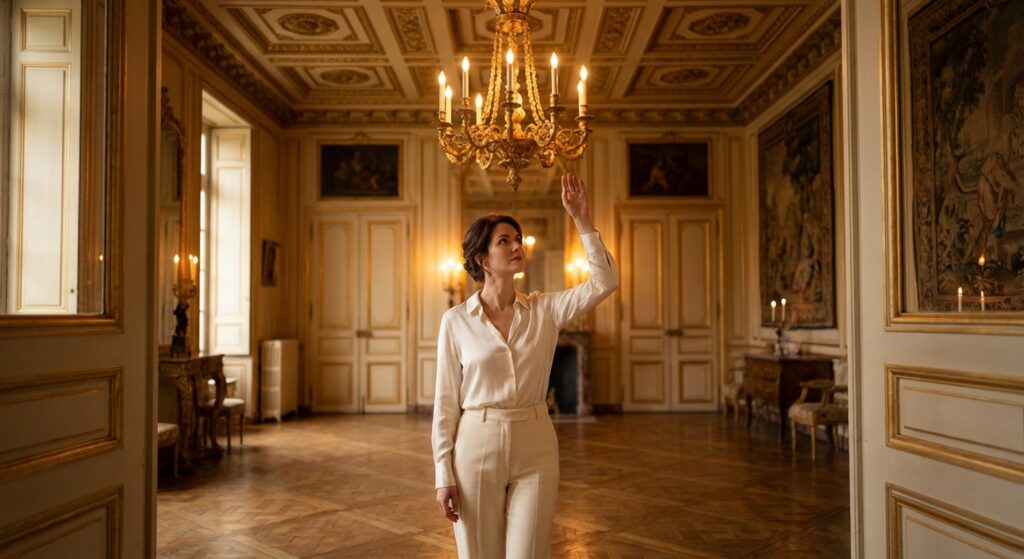
Why the Smart Home Market Collides with Classical Design
The global smart home market generated approximately $134.8 billion USD in revenue in 2023 and is projected by Statista to reach $231.6 billion by 2028, with the security and access control segment accounting for the largest share at over 29% of total market revenue in 2024, according to Statista’s Smart Home market data. The dominant hardware categories driving this growth — touchscreen control panels, ceiling-recessed speaker assemblies, climate sensors, and networked camera housings — are all designed for contemporary construction where flat drywall surfaces, suspended ceilings with standard 400 mm or 600 mm grid spacing, and exposed conduit runs are considered acceptable or invisible by convention.
Baroque and classically derived interiors operate on entirely different spatial rules. Cornice assemblies in authentic period or period-reproduction rooms typically project 120 mm to 280 mm from the wall plane. Ceiling coffers carry gilded or painted relief at depths of 18 mm to 45 mm. Wall paneling in the French boiserie tradition runs from floor to cornice in a system of vertical and horizontal members called stiles and rails, with individual panel faces recessed 8 mm to 15 mm behind the molding face. The substrate for this paneling is solid timber or engineered timber, not drywall. Retrofitting a standard 7-inch in-wall touchscreen housing — typically requiring a wall opening of 230 mm x 165 mm at a depth of 44 mm — into this kind of construction without pre-planning produces irreversible damage to both the decorative surface and, frequently, to the structural lath or masonry behind it.
The solution is not about hiding hardware after installation. It requires treating the entire technology infrastructure as a structural layer, designed, dimensioned, and clash-tested before a single decorative element is fabricated or installed.
3D Modeling as the Foundation of Hidden Tech Corridors
The term “hidden tech corridor” describes a spatial strategy in which all cabling, conduit, and equipment housings are confined to defined concealment planes that never intersect the decorative surface at an unplanned point. In classical rooms, the available concealment planes are three: the wall cavity between the structural substrate and the boiserie face (typical usable depth: 80 mm to 150 mm depending on construction type), the ceiling void above any suspended coffer or plasterwork plane (typical usable depth: 300 mm to 600 mm), and the raised floor plenum beneath engineered hardwood flooring (typical usable depth: 100 mm to 250 mm).
Planning these corridors requires a complete 3D model of the room in which each technology element is assigned a clearance volume. BIM software such as Autodesk Revit — which exports to the open IFC 4.0 standard — allows MEP (Mechanical, Electrical, Plumbing) coordination: the automated detection of any instance where a cable conduit trajectory would intersect a structural beam, a cornice anchor point, a load-bearing wall section, or an existing utility run. This clash-detection workflow, standard in commercial construction, is increasingly applied at the residential scale by premium integration studios.
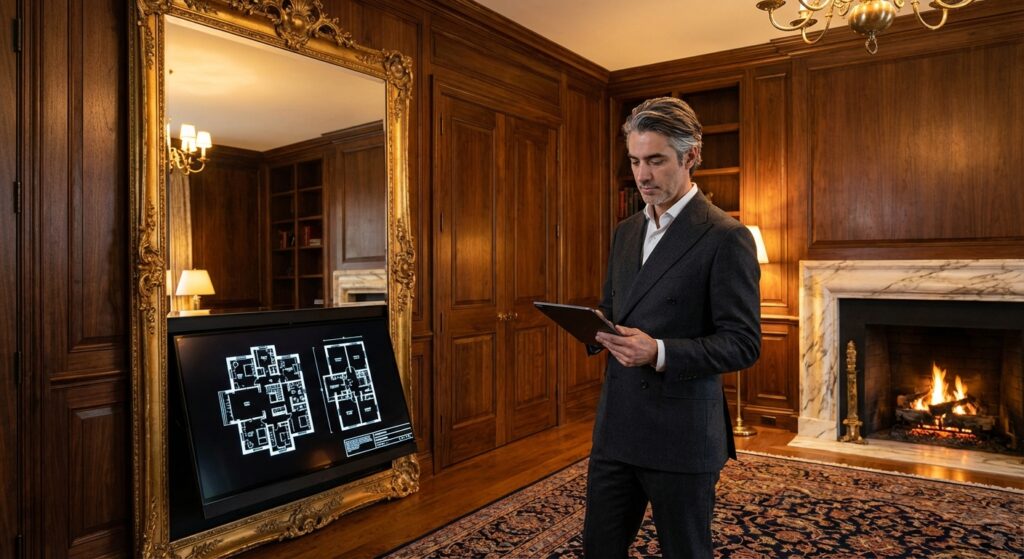
The practical output of this process is a set of approved cable routing drawings that specify, for each technology circuit, the exact path from the terminal device to the central equipment room. A typical 60 mm x 40 mm PVC cable management chase carrying Cat6A data and 24V DC power runs vertically within the wall cavity, enters the ceiling void at a pre-cut aperture, and terminates at a patch panel in the AV room — all without requiring any penetration of the decorative boiserie surface other than at the deliberately engineered access points.
Custom Boiserie as a Concealment Engineering System
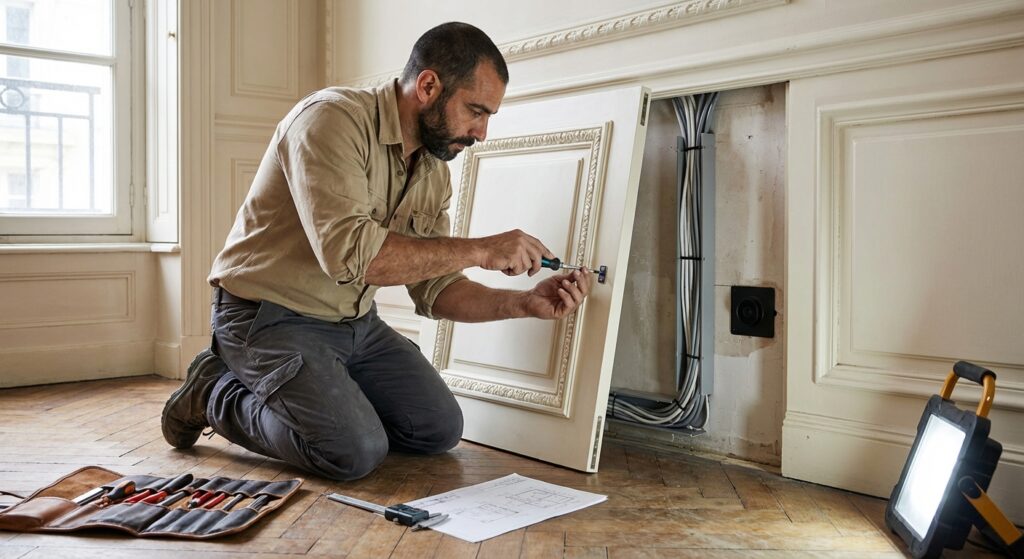
Traditional boiserie panels are fixed to timber grounds that are, in turn, fixed to the structural wall. The decorative panel face is a separate element from the grounds, which means that specific bays within a boiserie run can be engineered as removable access units without any visual difference from their neighbors. The two concealment methods currently in professional use are hinge-mounted panels with concealed piano hinges and magnetic-closure panels with rare-earth neodymium magnet assemblies.
Magnetic-closure access panels offer the most visually seamless result. A pair of grade N42 neodymium magnets with a combined pull force of 3.0 kg to 4.5 kg — sufficient to hold a panel of standard weight against normal air movement but releasable by deliberate manual pressure — can be set into the edge of the panel and its surrounding frame so that the joint line is continuous with the adjacent fixed panel molding. With precise machining and finishing, the gap at the closure joint matches the standard panel-to-molding gap of 0.5 mm to 1.0 mm across the full perimeter, making the access unit indistinguishable from fixed panels at normal viewing distances.
Behind these access bays, common equipment housings include IP camera enclosures, sub-bass speaker ports vented from an enclosure built into the wall cavity, network switch modules, and in some configurations, the electronic control units for motorized window treatments. The boiserie substrate at each access bay location must be fabricated from a dimensionally stable material — 18 mm or 25 mm MDF or birch ply laminate — rather than solid timber, to prevent seasonal movement from affecting the closure gap tolerance over time.
Voice-Activated Lighting in Period Rooms: Technical Specifications
Tunable white LED technology enables the full reproduction of light color from 1,800 Kelvin (equivalent to candlelight) through 2,700 K (warm incandescent) to 6,500 K (cool overcast daylight), with continuous dimming from 0.1% to 100% at resolutions imperceptible to the human eye. In a Baroque interior, integrating these light sources invisibly requires housing them within custom versions of period-appropriate fixtures rather than installing separate modern luminaires.
Girandole wall brackets and ormolu ceiling mounts cast or fabricated to match period precedents can accept MR16 LED modules (50 mm diameter, 35 mm to 50 mm depth) or GX53 surface-mount LED discs (53 mm diameter, 22 mm to 30 mm depth) within their lamp cups, with the LED driver electronics located remotely in the ceiling void and connected via low-voltage cable concealed within the bracket stem. Chandelier-scale ceiling fixtures can accommodate DMX512-addressable driver systems, with up to 512 individually controllable channels per DMX universe, allowing each lamp position in a multi-arm chandelier to be independently addressed from a central processor for sunrise, candle-flicker, or full-room scene effects.
Voice activation of these lighting circuits operates through a protocol bridge — typically a Zigbee 3.0 or Z-Wave Plus gateway — that receives processed voice commands from a concealed far-field microphone array and translates them to the appropriate DMX or DALI commands. The microphone array itself can be housed within the hollow interior of a ceiling coffer center medallion or within a custom-cast decorative element, requiring only a 50 mm to 70 mm diameter aperture in the plasterwork, which is acoustically transparent through a fine perforated grille painted to match the surrounding surface.
According to the U.S. Department of Energy’s Energy Saver program, residential LED systems consume at least 75% less energy than incandescent lighting and last up to 25 times longer. Beyond operational efficiency, LEDs emit substantially less UV radiation than the halogen sources they replace — a consideration with direct preservation value in rooms containing gilded surfaces, silk upholstery, or painted plaster, where UV exposure accelerates pigment degradation and fiber brittleness.
Climate-Controlled Wardrobes: Concealment Within Armoire Casework
Climate-controlled garment storage systems maintain interior temperatures between 14 degrees Celsius and 18 degrees Celsius and relative humidity between 45% and 55%, the ranges recommended by textile conservators for the long-term preservation of natural fibers, including wool, silk, and cashmere. The active cooling element in a typical residential unit is a Peltier thermoelectric module, which has no moving parts, produces no compressor vibration, and draws between 40 W and 120 W per module, depending on cooling capacity.
Integration into Baroque-style armoire casework requires that the cooling module, its heat sink, and its low-speed exhaust fan be housed entirely within the cabinet depth, which for a standard floor-standing armoire is 550 mm to 650 mm. The control interface is routed to a Zigbee 3.0 node concealed within the cabinet interior, making the entire unit operable via voice command or a smartphone app with no visible switch, sensor, or display on the exterior casework. The exterior surface can be finished in lacquer, fabric, or any material consistent with the surrounding room decoration.
Concealed Screen Integration: Load and Clearance Requirements
A 65-inch OLED panel weighs between 22 kg and 30 kg depending on manufacturer and panel generation. When housed in a motorized lift assembly behind a mirror-faced cabinet door, the total dynamic load on the wall fixing — inclusive of the panel, the motorized rail mechanism, and the mirror glass — reaches 60 kg to 90 kg. The wall-fixed steel sub-frame carrying this assembly must be engineered accordingly, with fixings into structural masonry or into a purpose-built timber or steel stud frame capable of sustaining the rated load with a minimum safety factor of 2:1.
The motorized lift mechanism typically uses a 24V DC linear actuator with a thrust rating of 100 N to 200 N, raising or lowering the panel through a vertical travel range of 400 mm to 600 mm over approximately 8 to 15 seconds. The mirror covering the screen in its concealed position uses low-iron float glass at 4 mm to 6 mm thickness with a dielectric partial-mirror coating achieving 50% to 65% reflectivity, which is sufficient to function as a working mirror while transmitting enough light for the display to remain clearly legible at standard residential brightness levels of 200 nits to 350 nits.
The UNESCO World Heritage Operational Guidelines require that any intervention in a heritage-designated or historically significant property be fully reversible without damage to original fabric. Custom boiserie enclosures for concealed screens satisfy this requirement when fixed to the structural wall using threaded inserts rather than permanent adhesive, and when all cable penetrations through original wall surfaces are made via removable conduit sleeves rather than direct chases cut into historic plasterwork.
Acoustic Engineering: Speaker Systems Behind Boiserie
Installing loudspeaker systems behind boiserie panels introduces two competing acoustic requirements. The enclosure needs a defined internal volume for accurate bass reproduction — a 6.5-inch (165 mm) woofer driver typically requires a sealed enclosure of 8 liters to 14 liters for flat low-frequency response — while the panel covering the enclosure must not resonate sympathetically in the 80 Hz to 400 Hz range, where thin wood panels are most susceptible to excitation by bass frequencies.
The standard engineering solution applies constrained-layer damping (CLD) treatment to the rear face of the boiserie panel at the speaker bay location. A CLD assembly consists of a layer of viscoelastic material bonded between the panel substrate and a constraining steel or aluminum sheet, creating a laminate in which vibrational energy is converted to heat through shear deformation rather than radiated as sound. Published research in the Journal of the Canadian Acoustical Association documented that adding a viscoelastic CLD layer to a wall assembly improved transmission loss by more than 10 dB across mid- and high-frequency bands, increasing the assembly’s Sound Transmission Class rating by 8 STC points. A mass-loaded vinyl (MLV) barrier layer of 1 kg per square meter to 2 kg per square meter applied between the boiserie and the wall cavity provides additional broadband attenuation at lower frequencies.
The network audio protocol most commonly used in high-specification residential installations is Dante, developed by Audinate, which routes uncompressed audio over standard Cat6 or Cat6A Ethernet at latencies below 1 millisecond and supports up to 512 channels per network on a Gigabit Ethernet infrastructure. This means the same Cat6A cabling plant that carries the home automation data also carries the audio distribution, eliminating the need for separate speaker cable runs and allowing any audio source to be routed to any room with a configuration change in software rather than a physical rewire.
Security Systems: Camera Concealment in Decorative Frames
Contemporary 4K IP security cameras with wide-aperture lenses — typically f/1.6 to f/2.0 — are available in housing diameters of 35 mm to 60 mm, small enough to be recessed within the depth of a carved decorative frame or cartouche surround. The camera face is covered by an acrylic or glass window with a partial-mirror or near-neutral tint that allows the lens to record at full resolution while appearing, from the exterior, as a decorative glass insert within the carved frame.
Network video recorders (NVRs) and the associated storage infrastructure are rack-mounted in a dedicated AV room — ideally a service corridor or storage room adjacent to the main living spaces with a minimum clear width of 900 mm — connected to camera and access control devices via Cat6A shielded cabling rated to 10 Gigabit Ethernet. Power over Ethernet (PoE++ per IEEE 802.3bt) delivers up to 90 W per port to powered devices including cameras, access readers, and wireless access points, eliminating the need for separate power supplies at each device location and reducing the number of cables entering each concealment bay to a single Cat6A run.
Technical Comparison: Concealment Methods for Smart Home Hardware in Classical Interiors
| Device Category | Typical Hardware Dimensions | Required Concealment Depth | Concealment Method | Control Protocol | Key Constraint |
|---|---|---|---|---|---|
| Tunable LED lighting | MR16: 50 mm dia., 35-50 mm depth; GX53: 53 mm dia., 22-30 mm depth | 35-55 mm within fixture housing | Custom-cast period fixture with remote driver in ceiling void | DMX512 / DALI / Zigbee 3.0 | Driver heat dissipation; min. 100 mm air gap around driver |
| Far-field microphone array | 50-70 mm diameter module, 20-30 mm depth | 30 mm plus acoustic cavity | Concealed within ceiling coffer medallion or decorative casting | USB / Ethernet to central hub | Acoustic transparency of cover grille; paint must not block perforations |
| In-wall loudspeaker | 6.5 in. (165 mm) woofer; enclosure 8-14 L | 120-180 mm wall cavity | Boiserie panel with CLD treatment; MLV barrier 1-2 kg/sqm | Dante / AES67 over Cat6A | Panel resonance control; enclosure volume within cavity |
| Concealed display (motorized) | 65 in. OLED: 22-30 kg; housing depth 80-110 mm | 110-140 mm recess plus boiserie face | Motorized lift behind partial-mirror panel; 24V DC, 100-200 N actuator | RS-232 / IP control | Wall sub-frame load: 60-90 kg dynamic; full reversibility via threaded inserts |
| IP security camera | 35-60 mm dia. housing; f/1.6-f/2.0 lens | 60-100 mm recess | Recessed within carved frame or cartouche; tinted acrylic face | ONVIF / Cat6A PoE++ (IEEE 802.3bt, up to 90 W) | Acrylic face must not cause lens flare; avoid retroreflective coatings |
| Climate wardrobe module | Peltier module 40-120 W; fits within 550-650 mm cabinet depth | Within standard armoire casework depth | Integrated into period-style armoire; exhaust to ceiling void | Zigbee 3.0 / Z-Wave Plus | Condensate drainage; heat exhaust routing to avoid wall cavity moisture |
| Network / AV rack | 19-inch rack; minimum 900 mm room width required | Dedicated service corridor or AV room | Repurposed service room or purpose-built enclosure behind joinery | Cat6A 10GbE; IEEE 802.3bt PoE++ | Ventilation: min. 6 air changes per hour in rack enclosure |
The Reversibility Requirement in Heritage and High-Value Properties
Any technology integration project in a property of documented historical significance — or in a new-build replica of a historical interior intended to preserve long-term authenticity — must be designed so that the entire installation can be removed without damage to the original or original-quality decorative fabric. This means no adhesive fixings to historic plasterwork, no permanent chases cut into original masonry for cable routing, and no load-bearing modifications to structural elements without engineering signoff and reversible detailing.
In practice, the reversibility requirement reinforces rather than conflicts with the concealment strategy described in this article. Boiserie panels fixed to timber grounds via screwed connections and removable cable conduit sleeves can be demounted completely, the cable infrastructure removed, and the wall surfaces returned to their pre-installation state with only minor filling and repainting at screw locations. This is not achievable with conventional smart home retrofit approaches that rely on surface-mounted cabling, clip-fixed conduit, or adhesive-bonded sensor mounts — methods that leave visible damage and residue when removed.
For new construction with Baroque-style interiors built to the same dimensional and material standards as historical precedents — the category that represents the majority of ultra-high-net-worth residential commissions in the Gulf, Central Asia, and Southeast Asia — the reversibility principle applies equally, since the decorative investment is comparable to that of a protected heritage property and the client’s expectation of long-term visual integrity is identical.
Acoustic research on constrained layer damping published in Scientific Reports (Nature Publishing Group, 2023) confirms that CLD-treated panels demonstrate significant sound transmission loss improvements at modal resonance frequencies, establishing the acoustic performance basis for the boiserie-concealed speaker system described above as a technically sound and peer-reviewed engineering approach rather than a proprietary claim.